
Smile at the dog
We smile at every dog we pass, as instinctively as we smile at babies. Do they have any idea what we are doing?

A Labrador comes the other way on a narrow pavement and something happens to your face before you have agreed to it. Forty metres later, a Spitz, and it happens again. You do not do this for the human holding the lead, who gets a nod at most, and you would not do it for a stranger on the metro without being asked what exactly you wanted. The smile skips the human entirely and lands on the dog, as openly as the face we make at a baby through a café window.
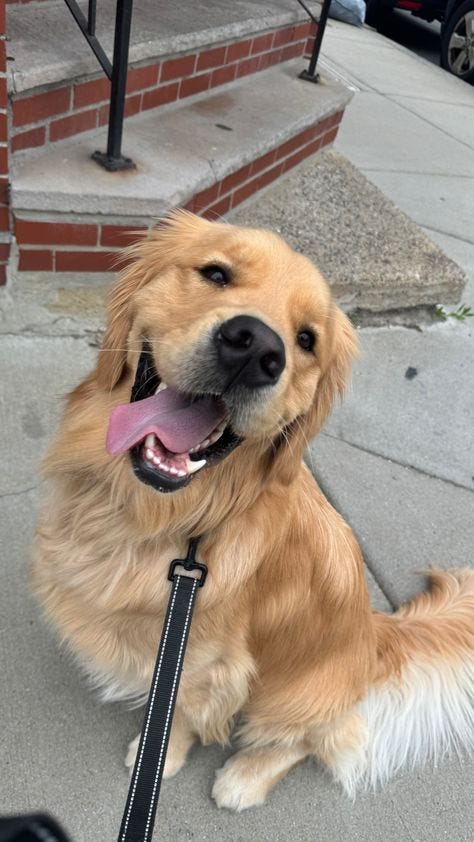
And it is not a city reflex. A dog trotting across a village square, asleep under a restaurant table, waiting outside a bakery in a town you are only driving through: wherever one appears, the place lifts, and so does your face. Almost nobody stops to ask whether any of it lands. Does the dog understand the smile, or are we performing warmth at an animal who is mostly wondering about our pockets?
They understand. Better than we assumed, and not quite in the way we imagine.
They know that face
A dog coming towards you is reading your face for its state, and the pleased one means to them roughly what it means to us: nothing here needs managing. They are not deducing it from your voice, or from the fact that you slowed down. They take it from the face itself, because they have spent their whole lives among creatures who wear these expressions all day, and because knowing which one is approaching has always been worth their while.
Researchers in Vienna confirmed all of this properly in 2015, and elegantly. They trained dogs on photographs of the same person looking happy and looking angry, showing each dog only half the face, then tested them on the halves and the people they had never seen. The dogs passed every version of the test, which means they were not memorising pictures. They were recognising an emotion. And the dogs rewarded for picking the happy face learned faster than the ones assigned to the angry one, because approaching an angry face is something a dog does reluctantly, even in a laboratory, even for food.
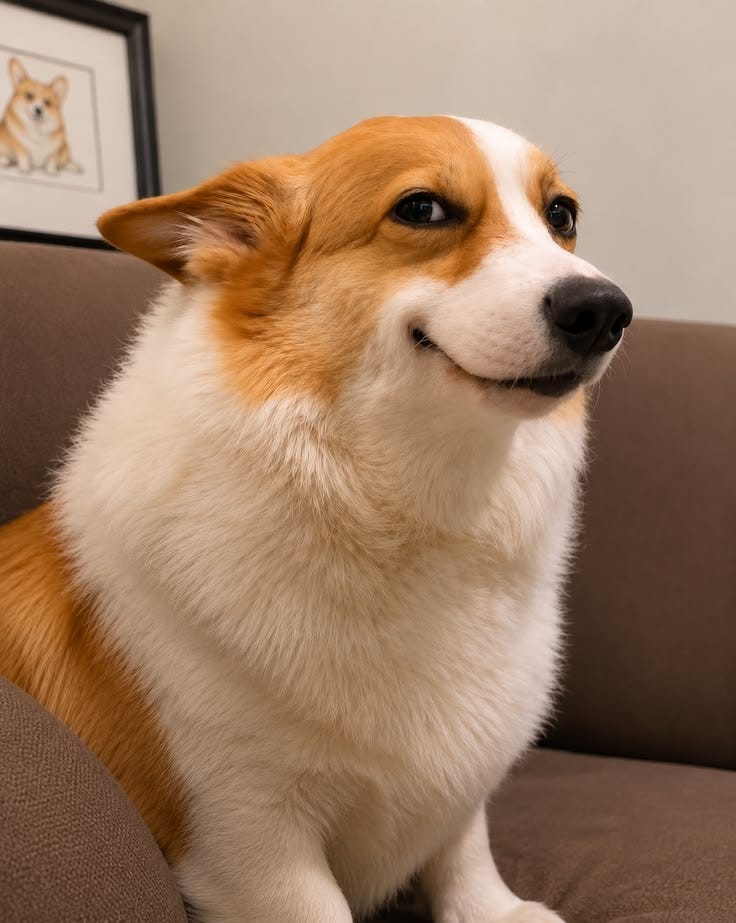
There is a small translation miracle hiding in there, worth admiring. In their own language, bared teeth are a threat, and a dog showing you its teeth is not joking. Yet somewhere along the way they worked out that when we do it, with the soft eyes and the loose body attached, it means the exact opposite, and they run the conversion every day without apparent effort. The one courtesy worth returning is to keep the smile moving with an unfamiliar dog rather than pinning them with a long stare, which in their grammar is pressure. Smile in passing, glance away, and the message arrives perfectly.
But they are not reading your mouth
We picture it wrong, though. We imagine the dog studying our smile the way we study theirs, eyes locked on the features, decoding the mouth. The truth is stranger and more flattering. To a dog, you have no close-up. You are a single moving fact, read whole, and your face is one instrument in an orchestra you cannot hear yourself playing.
The evidence for this is one of the more humbling brain scans of the past decade. In 2020, researchers put dogs and humans in scanners and showed both species the same videos of faces and the backs of heads. The human brain behaved as expected, with whole regions devoted to faces flaring at every close-up, because we are a species that reads destinies in a raised eyebrow. The dog brain did something else. It made no distinction whatsoever between a face and the back of a head, and what set it alight was the creature itself, above all whether that creature was a dog. All those years we assumed they were looking at our faces the way we look at theirs, they were watching the whole animal.
Which explains a result from Naples in 2016 that every dog trainer recognises on sight. Dogs fluent in both spoken commands and hand signals were given the two at once, the voice asking for one action while the hand pointed to another. The dogs went with the hand. Between what we say and what we do, they trust what we do, and anyone who has ever reached quietly for the lead and watched a dog materialise from another room already knew. So the smile lands, but it lands as part of you. Your stride carries it, your shoulders confirm it, and by the time you register the dog, the dog has finished reading you.
The proof lives with deaf humans
If you want to see what a dog can extract from a face alone, watch what happens when the voice is taken out of the equation entirely.
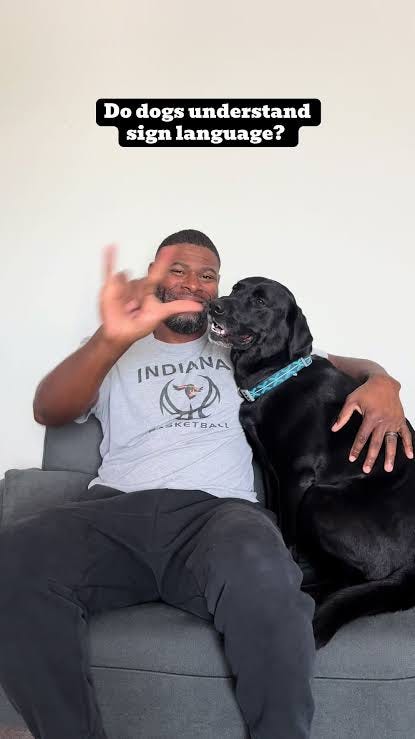
Deaf humans have been living with dogs, and training them to a high standard, for as long as anyone else. Everything a hearing household delivers through tone, the delighted pitch of good dog, the dropped register of the reprimand, gets rerouted through the hands and the face. The wide, open smile becomes the reward. The frown becomes the correction. There is a whole genre of this on TikTok now: a deaf human catches their dog mid-mischief, says nothing, moves nothing, and simply lowers the eyebrows. The dog folds instantly, ears back, the full theatre of being caught. No word was available and none was needed.
Trainers who work with deaf dogs report the mirror image, that dogs deprived of sound become spectacular readers of the human face and hands, checking in visually every few seconds. The channel was always there. Sound was just the loud thing layered on top of it.
They built a face for us
And they have not been sitting still in all this. While we were learning to smile at them, their faces were changing.
In 2019, researchers comparing the facial anatomy of dogs and grey wolves found a muscle in the dogs that the wolves essentially lack: the one that lifts the inner eyebrow. It is the muscle behind the look every human on earth recognises, the raised, faintly worried eyes that make a dog seem on the verge of asking a question. Wolves can barely produce the movement. Dogs deploy it constantly, and most of all when a human is watching. The researchers' reading was that we did this to them over thousands of years, favouring, litter after litter, the faces that seemed to speak, until the equipment for the expression became standard issue.
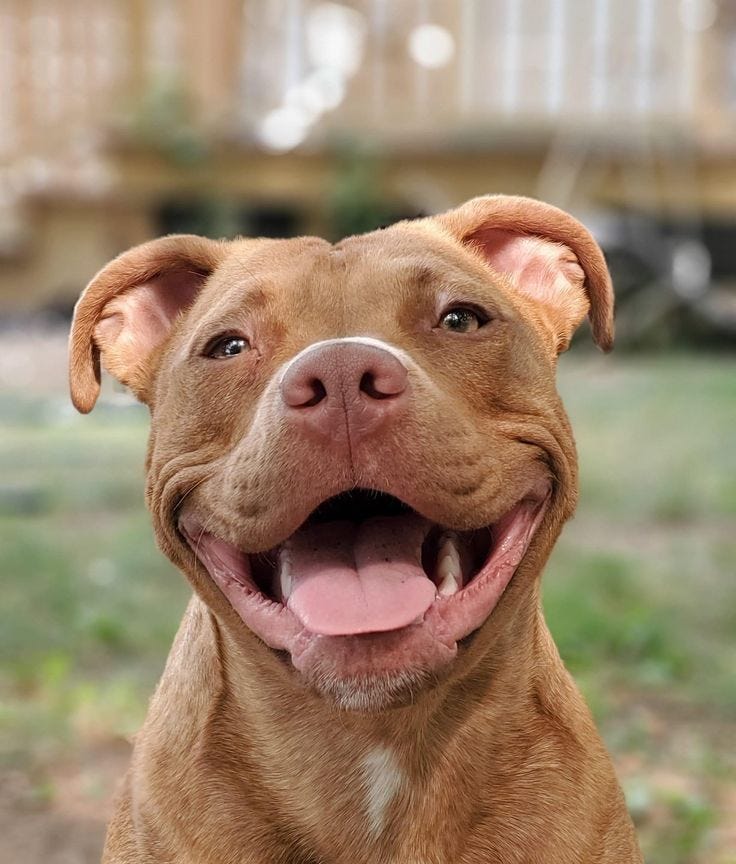
They aim it squarely at us, and it works with a reliability most advertising agencies would kill for. We arrive at the pavement with a smile we cannot suppress. They arrive with an eyebrow engineered to be irresistible. Neither side is entirely in control of the exchange, which may be the most honest thing about it.
And the love hormone is a different story
Someone always brings up oxytocin here, usually the version where gazing at your dog triggers the same hormonal loop as a mother nursing an infant. The study is real. It is also about long mutual gazing between dogs and the humans they live with, measured over half an hour alone in a room, and the mother-and-infant line is the researchers' own interpretation rather than anything they measured.
Which, if anything, makes the whole arrangement lovelier. The chemistry is reserved for the dog who knows you, the one who has spent years memorising your face and can hold your gaze on a slow Sunday morning until you both feel it. What you exchange with a Labrador in three seconds on a pavement is something lighter, a flirtation rather than a marriage, and it asks nothing of either of you. The deep loop is waiting at home. The pavement is just for joy.
So keep smiling
Here is the part worth keeping. The dog gets it. That involuntary thing your face does at the sight of a Labrador is received, filed and understood, by an animal who has spent their whole life becoming fluent in exactly this. Of all the species on the planet, we happen to share our pavements with the one that learned to read us.
And be honest about what we get out of it, because the traffic runs both ways. The smile feels good to make. It costs nothing, asks nothing, negotiates nothing. There is no small talk to survive afterwards, no impression to manage, none of the accounting that shadows every human exchange. For three seconds you are simply pleased, in public, at something openly and unapologetically alive, and the face responds before the brain files a report. On certain days, the grey ones stacked with emails and delays and news, that dog on the pavement is genuinely the nicest thing that happens to you. Both of you walk away lighter, and neither of you will think about it again, which is precisely what makes it perfect.
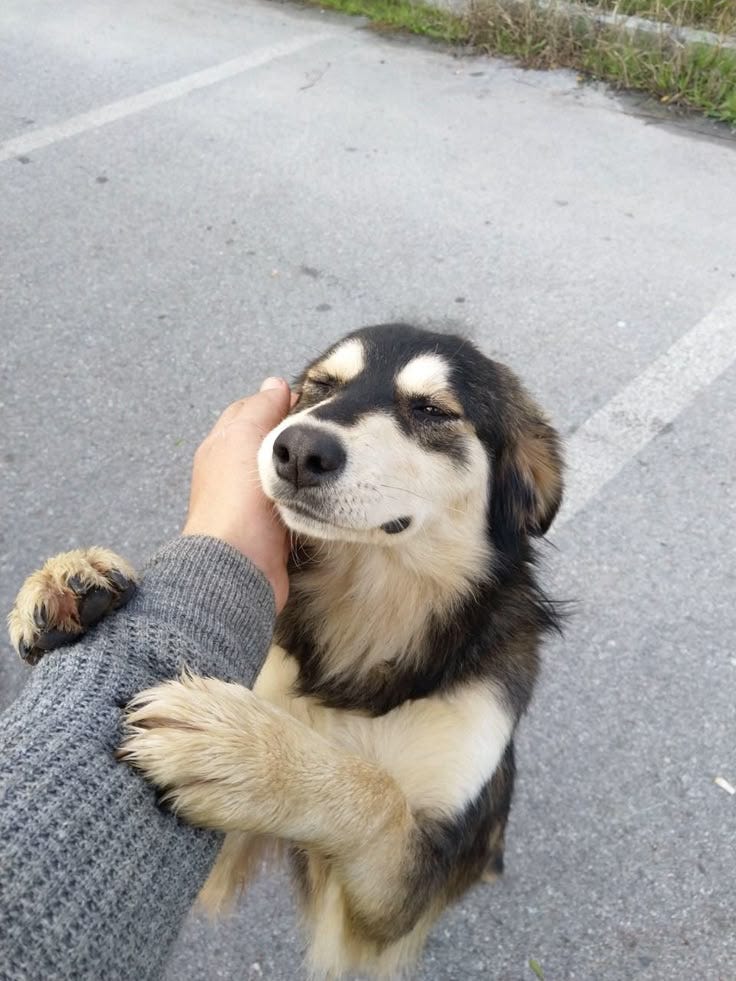
So smile at the Spitz. Smile at the Labrador, the Beagle, the enormous thing that might be part bear. They understand. They have always understood. It was us who needed the studies.
— Datcha
They are so precious
Occasionally my dog seems to register “that’s an unfriendly person.” I don’t see it but I trust him. I’d bet they can read our smile without even looking up - maybe by body language or smell.