
The Eldest Child
On the Chronological Hierarchy of Cosmopolitan Households

Before the stroller, there was the leash. In our modern households, the dog came first. A chronological banality that silently redefines the entire architecture of the family
In the vast majority of households that today contain both a dog and a child, the dog was there first. By two years, sometimes by seven. The configuration varies — couple, solo parent by choice, single parent after separation — but the order of arrival is the same. This order is so banal that it underpins every conversation about the modern family without ever being addressed directly. Yet it shapes almost every decision the household makes: the choice of neighborhood, the vacation destination, the allocation of the sofa, and the military logistics of a rainy Tuesday morning at seven o'clock.
This chronology is not a mere trend. In France, the national statistics bureau (INSEE) noted last summer that the average age for a first maternity has now risen to 29.1 years (up from 24 in 1974). The European Union average is hovering around 30. Italy peaks at nearly 32, closely followed by Japan. Across the cosmopolitan belt — Paris, Milan, London, Tokyo, New York — the first child lands in a household the dog has already shaped.
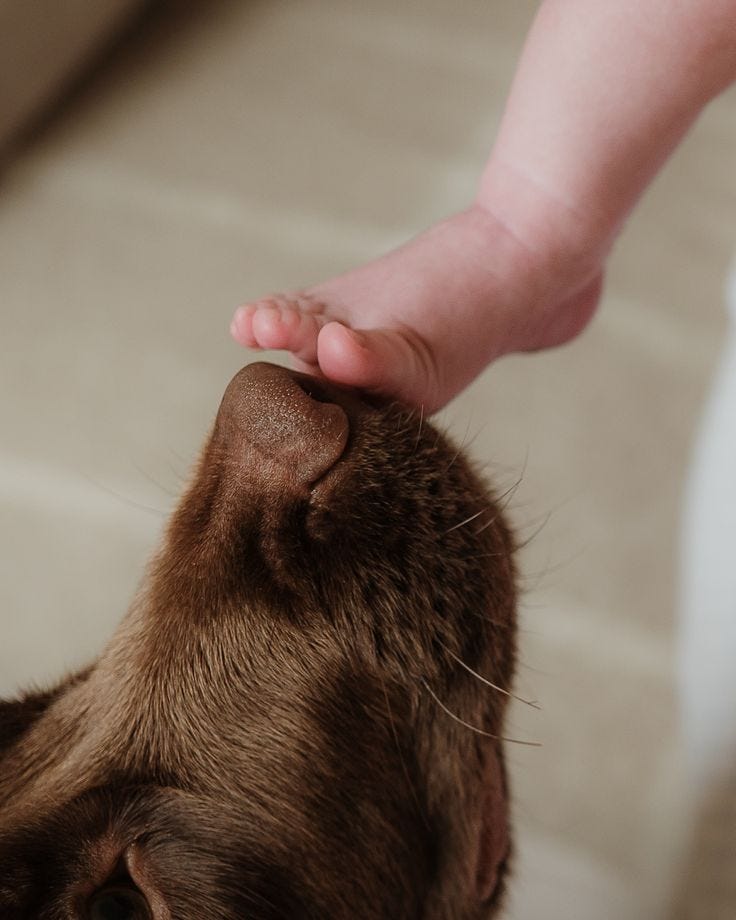
The "Wallet Share" Market Crash
The dog came first because it was acquired during that golden parenthesis when a couple has built a life, but not yet a family. Demographers call them DINK households (Double Income, No Kids - read our dedicated article about them). For solo professionals at the same life stage, the dynamic is similar — built life, no family yet, full attention on the dog.
During this period, a massive share of disposable income and time is directed toward the dog. The apartment was chosen for its ground-floor garden. The neighborhood was vetted for its park. Financially and emotionally, the animal enjoyed an absolute monopoly: dog osteopaths, weekends by the sea, and constant attention.
But when the baby arrives, the household suffers an intimate market crash. The "wallet share" and mental bandwidth shift abruptly. The energy once allocated to long walks is siphoned off by sleepless nights, bottles, and the colossal mental load of a newborn. The new arrival enters a household initially structured for someone else, and the furry eldest is, de facto, quietly demoted.
Why the Demotion Isn't Malice
Easy to judge parents who neglect their dog after childbirth. But what if this demotion wasn't an act of malice? What if it was, quite simply, a biological survival reflex in the face of exhaustion?
When an infant is screaming at 3 a.m. for the fourth time, the fact that the dog didn't get its long walk in the woods becomes the least of your worries. New parents are wired for the infant first — this is biology, not preference. Everything else goes on standby. The dog becomes, despite the love we bear it, a logistical adjustment variable.
The tragedy is that the dog's biology couldn't care less about our excuses. The animal, accustomed to the family's hyper-availability, finds itself bombarded by the infant's cries, constant comings and goings, and a cruel lack of stimulation. It is precisely in this involuntary neglect that behavioral issues are born: nuisance barking, destruction, signs of reactivity.
And this is where the trap closes. Exhausted by the baby and overwhelmed by a dog that is "becoming unmanageable," some parents end up committing the irreparable: abandonment. Veterinary schools and rescue organizations now treat baby preparation as a systemic operational issue — the literature on owner surrender, from Best Friends Animal Society's analysis of over a million classifiable cases, consistently identifies human life transitions, not the dog's own behavior, as the primary trigger. The abandonment is an ethical capitulation. It is also the predictable outcome of a household that allowed chaos to settle in instead of anticipating it.
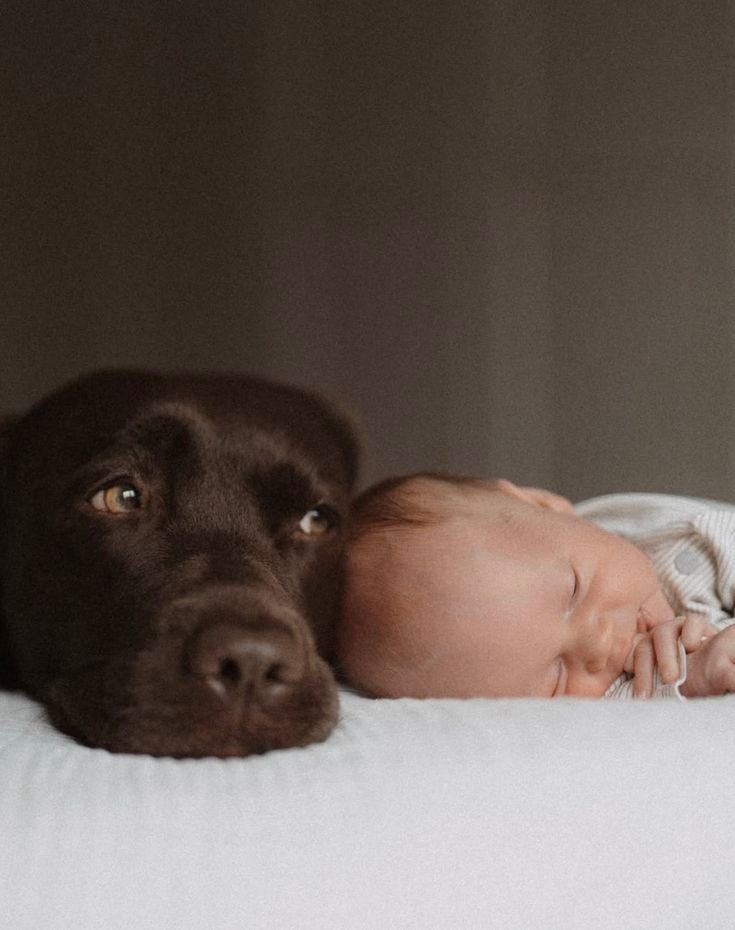
The Engineering of Cohabitation
Demotion is not inevitable. It requires project management, not better intentions. These principles apply whether there are two adults sharing the load or one carrying it alone — but for the solo parent, the margin for error narrows and the outsourcing becomes structural, not optional. A few strict operational principles change the entire trajectory:
The Principle of Invariance (the micro-ritual). The dog doesn't need everything to stay the same; it needs just one thing that never changes. Fifteen minutes of exclusive playtime in the living room while the baby sleeps, or the first morning walk one-on-one. This safeguarded micro-ritual maintains the bond and reassures the animal.
Tactical outsourcing. Since the parent's — or parents' — time and energy will collapse, delegation is required. Even before birth, the budget should include a professional dog walker two to three times a week for the first few months, or a few days in daycare. It is an investment in the dog's mental health (they burn off energy) and the parent's (they get to breathe).
Logistical desensitization. You do not wait for the return from the maternity ward to change the rules. If the dog is no longer allowed to sleep on the bed, this rule must be implemented six months before birth. The dog must not associate the loss of a privilege with the arrival of the baby.
Space sanctification. A baby gate doesn't just protect the child. It primarily serves to offer the dog a "green zone" inaccessible to the toddler — a retreat where the animal will never be solicited, touched, or disturbed.
The New Demographic Truth
The goal is not to love your child less to make room for the dog, but to structure a household capable of absorbing both.
Tokyo digested this equation two decades ago. Japan today counts more pet dogs and cats (15.9 million) than children under the age of fifteen (13.7 million). Milan and Rome are following the same curve, coupling the latest maternities in Europe with a massive urban dog population.
In these metropolises, the eldest-child question structures the household by default. The arrival of a child should no longer signal the planned obsolescence of the dog, but rather seal the maturity of a growing family. The eldest remains the eldest, the youngest takes their place, and the architecture of the household finally reflects the chronological truth of its history.
The dog acquired in the late twenties has already taught the household what no manual ever could: the discipline of caring for a life that does not negotiate, the patience of broken nights, the slow apprenticeship of unconditional love. By the time the child arrives, the grammar exists. The reflexes are there.
What the dog taught the parents, the dog will then teach the child. Responsibility, empathy, loss, the reading of silence. And the children raised this way do not become like the others. A subject that deserves its own article, and will get one.
This is what a mature household looks like at thirty-five — an architecture built to hold two dependents whose statuses will never be the same, and a quiet certainty that the eldest, by being there first, has already shaped everyone who came after.
- Datcha