
Heatwave: when the city lets your dog suffocate
The warming is here, the cities aren't ready, and the dogs are paying for it loudly.

It is half past midnight in Paris. The flat reads 30°C (86°F), and so does the street outside. The fan only moves hot air around. The dog lies flat against the floor tiles, the last cool surface left, and pants. On the phone beside the bed, the same scene loops in other people's feeds: the news bulletins, the vets' warnings shared ten thousand times, the reels of dogs hosed down on balconies. We have never talked this much about what a heatwave does to animals, and it has never been less clear what any of that talk is for.
This was the week. Not one household but millions across France, awake at the same hour over the same panting animal, watching a heatwave do to their dogs what no amount of love could stop. The scene at the centre of it was posted by the musician Johanna Rey-Jasse.
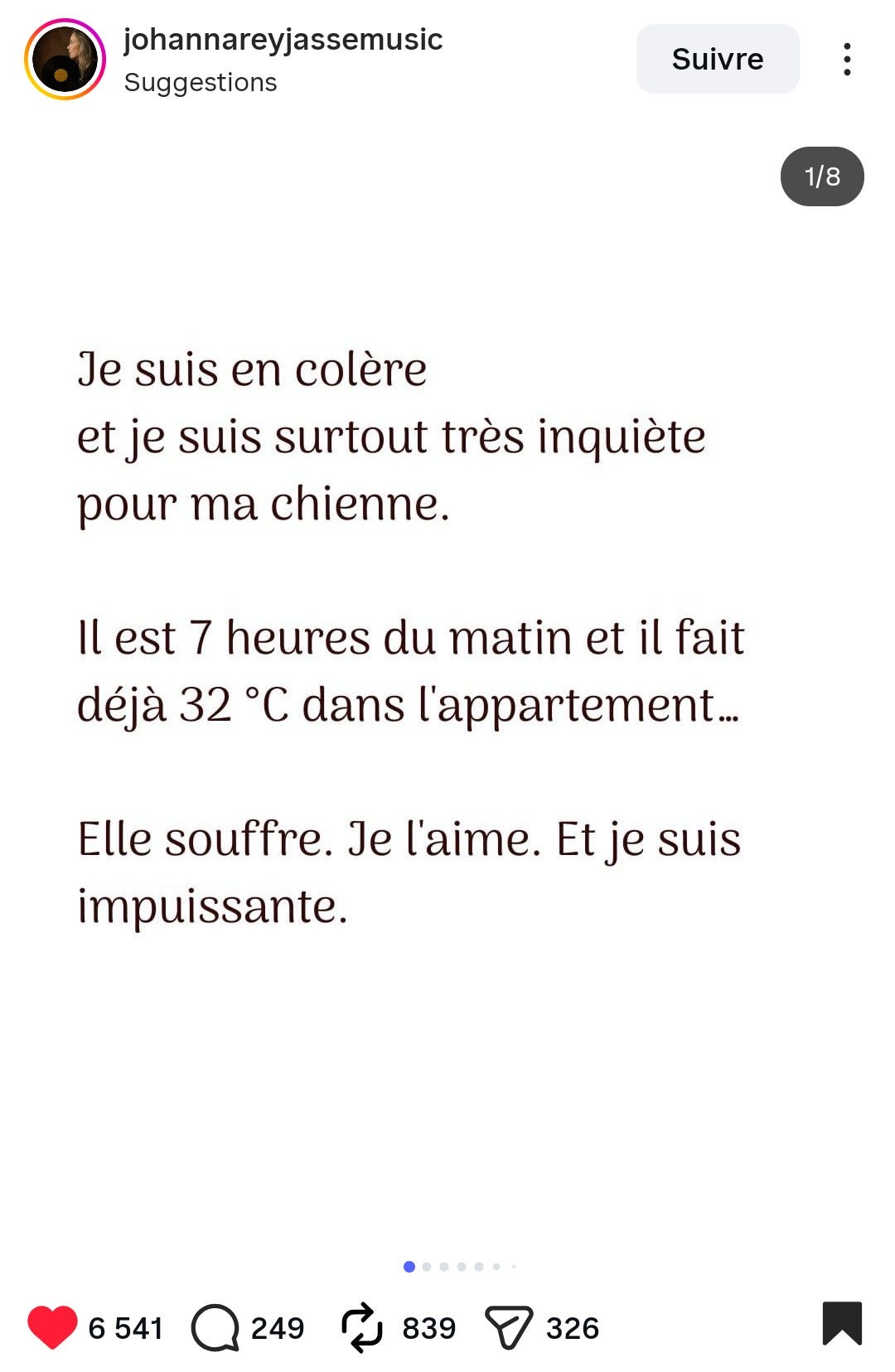
"She is suffering. I love her. And I am powerless."
Hold onto that last word. For all the coverage, nothing in the city has changed: the same locked doors, the same furnace indoors, the same walk that cannot be taken. This is a piece about that gap, about what it takes to keep a dog alive in a city not built for this heat. Paris is the sharpest case, but the trap is continental. And if you are reading from Texas, from Queensland, from anywhere that has always been hot, you may know it from the other side, as the thing your city solved decades ago and ours is only now, expensively, discovering.
The facts in one breath. The 24th of June 2026 was the hottest day ever recorded in France, a national average of 29.9°C (86°F). Three quarters of the country went red, never reached before. At 41°C (106°F), Paris was as hot as Dubai that week, a comparison the bulletins reached for again and again, except Dubai has been built since its foundations to take that heat and Paris was built to be looked at. The capital did not fall below 26.4°C (80°F) at night, and the same dome flattened London, Madrid, Rome and Brussels at once. This was Europe's furnace, and the *second* heatwave of the year after May's, two before summer had officially begun. The climatologist Françoise Vimeux gave it the only honest framing: this is the coolest summer of the rest of our lives, if we fail to decarbonise.
Why the dog dies first
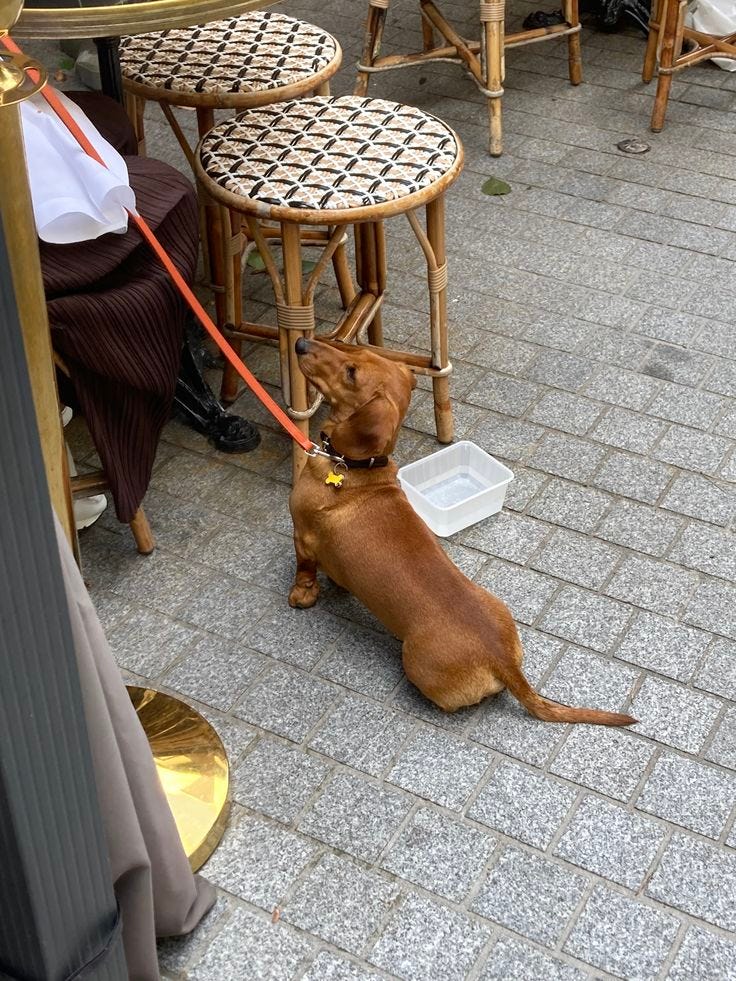
A dog barely sweats. He cools himself almost entirely by panting, a system that quits the instant the air he breathes is as hot as he is. You shed a layer and find the shade; he has no brake. Past 41°C inside, the body turns on itself: the proteins break down, the cells die, and what follows is a generalised failure of every organ at once, the heart, the kidneys, the brain going down together. Heatstroke can take him in fifteen minutes, and even treated fast, it kills one dog in two once the gut starts to bleed.
This week the bodies arrived. The 3115 veterinary line logged a 9.5% rise in heat deaths among companion animals over last year, the dogs in the front line, most struck down not in locked cars but on an ordinary midday walk.
Dogs are dying right now, all across France…
… the service warned, and the cause was rarely the negligent owner of the imagination. It was the normal walk that kills. And some are far more exposed, the flat-faced breeds, the French bulldog, the pug, the boxer, whose shortened skulls leave the airway folded and the panting all but useless. For them a walk in ordinary summer heat is already a risk, and on tarmac that hits 60°C (140°F) when the air is at 35°C (95°F), burning through a paw pad in seconds, it turns fatal fast.
A day in a city built against the living
Multiply that midnight scene by the roughly 100,000 dogs who live in Paris, and you have the week the city went through. It runs to a cruel clock.
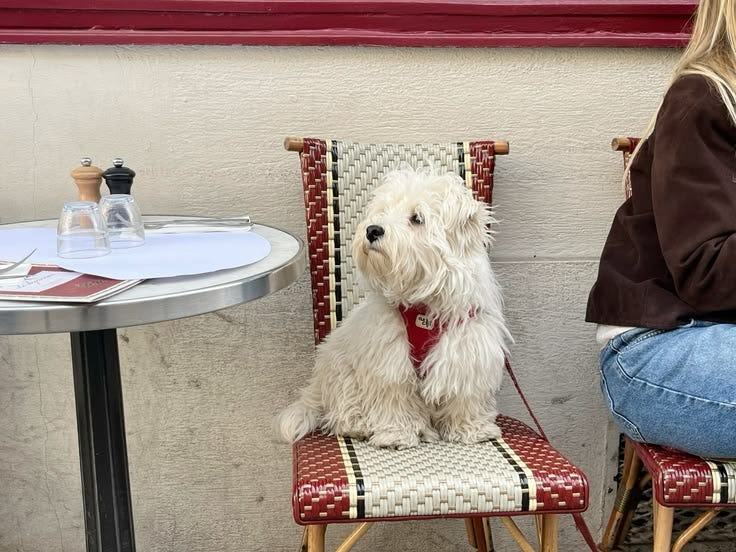
The day begins before dawn, though no one slept. You take the dog out by seven, the last safe hour, because by nine the tarmac burns. There is nowhere soft to go: Paris has almost no accessible lawn, and the parks with grass forbid walking on it. And the home is no refuge. Under the zinc that makes the postcard, top-floor rooms climb past 60°C and hold there; the building traps the day's heat and never lets it go. None of this is carelessness on the residents' part. Barely one Paris flat in eight has air conditioning, and the protected façades forbid the very shutters and pale walls that might have helped. When people did go looking to buy a unit this week, the shops had sold out in hours, delivery pushed back weeks. France has long kept the machine as a last resort, a faint shame, for the planet's sake. So by midday the flat is the second furnace, and there is no quick fix to reach for.
So you go looking for cool, and this is where it turns absurd. Every cool room in the city is shut to the dog. The supermarket, on hygiene grounds, though Italy reads the same EU rule and lets the dog in. The chemist. The bank. The air-conditioned hall. The métro will take him but the bus will not, and underground he must be muzzled or you pay 150 euros, the law clamping shut the one organ he cools himself with, in the middle of a heatwave. And there are almost no dog parks to fall back on. This week, the coolest place some people found to let a dog stretch his legs was an underground car park, a few degrees below the street, because it was the only large cool space in the city with an open door and no rule against the animal.
So you go home and wait out the heat, and the night brings nothing, because Paris did not drop below 26.4°C after dark all week. Then the vigil: towels wrung out at two, then four, a hand on the ribs counting breaths, the emergency line open, no sleep, because a heatstroke at three in the morning kills before help arrives. There was nowhere, at any hour of any day that week, that a dog and the person beside him were reliably allowed to be cool. Not one hour. The city was never built to hold heat off anyone; it was built in stone, for show, and the dog only feels it first. Those who could ran, drove out chasing shade or booked a hotel room for the air conditioning, until relief became something you buy and survival turned on a bank balance. Everyone else had the feeds, the same plea in a hundred voices: we live under the roof, our animals are suffering, help us. Not outrage. Pleas.
The theatre that stands in for action
Faced with all this, the City of Paris did something, and announced it on Instagram in the bright tone of a man unveiling a breakthrough. The mayor, Emmanuel Grégoire, set out the figures: every park open round the clock, 550-plus green spaces, and 14 parks normally closed to dogs added to the list for the duration. The number worth holding onto is a quieter one. Of those 550 green spaces, only 164 normally let a dog in at all, plus 44 dedicated dog runs. The rest of the city's green, the great majority, refuses the animal by default, every ordinary day of the year. The 14 extra parks open the morning the heat arrives and shut again the morning the alert lifts. A plaster, peeled off the instant the skin stops bleeding in public.
So ask the only question that matters once the heat breaks: what do we keep, what do we change? On current form, nothing and nothing. The parks revert, the by-law that bans dogs by default stays as it was, and the city waits for the next heatwave to reopen the same gates to the same applause. The temporary exemption wins every time, faster, easier to announce, quietly reversible. We have not run out of solutions. We have run out of the will to make any of them permanent. The animal charities know the move by name and call it what it is: animal-washing, the small gesture that is easy to stage and changes nothing structural.
Why others survive the heat and we do not
None of this is fate, and the proof lives one Eurostar away. London never had to fling its parks open, because they were never shut to dogs: in the Royal Parks the animal is welcome by default, the restriction the exception rather than the rule, the city 47% green. Paris starts from *the dog is forbidden* and rations exceptions; London starts from *the dog belongs here*. So while Paris prised loose 14 parks for a week, London spent the heatwave debating how to write the animal permanently into the city to come.
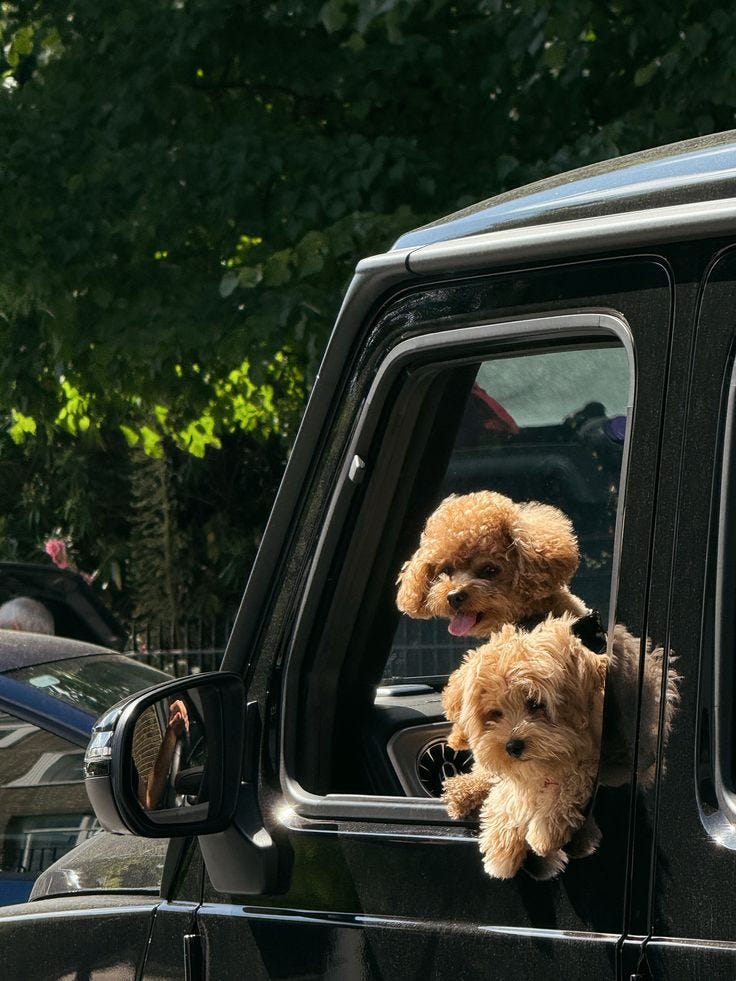
Nor is it luck of geography. Seville, hotter and drier than Paris, made shade a public works programme: 5,000 trees planted every year since 2020, fountains, white awnings strung between the streets, and a revived version of a 3,000-year-old Persian cooling technique, the qanat, that drops the air on its pilot site by 8 to 9°C. Singapore, hot all year round, designs the dog into the city rather than tolerating him in a crisis: a network of fenced runs with shade, water taps and wash points as municipal standard, one of them built on a shopping-mall rooftop, ventilated and integrated, the opposite of a car park found by accident. Australia keeps its dogs leashed by default too, and shuts its summer beaches much as France does, so it is no utopia; but a continent that has always known 40-degree summers built the infrastructure to match, fenced parks with shade and water, off-leash foreshores, maps of where a dog can actually go.
These cities decided, long ago, that a city is a place for living bodies, while Paris decided it was a monument, and is now astonished that monuments hold heat. The sting is that Paris already owns much of the cure: nearly 1,800 islands of cool around 26°C, 1,200 fountains. The infrastructure is not entirely missing. Often, only the decision is.
And the decision is not the city's alone. A heatwave is also solved, or refused, one door at a time, by everyone who runs a space with cool air behind it. The café that puts a water bowl down and waves the dog in, the hotel that keeps its lobby open to the animal, the shop that decides hygiene is not threatened by a setter on a lead. None of them waits for a climate plan; each quietly does what the city will not. A more welcoming city is not a utopia to be petitioned for, it already exists, in the places that have chosen to open the door. In a city this hot, that hospitality is not decoration on the climate question. It is part of the answer.
The dog is the warning, not the footnote
A heatwave never strikes a city evenly. It finds the exposed: the people sleeping rough, the elderly alone on a top floor, the ones whose medication stops the body regulating its own heat, the infant, the sick, and the dog, who cannot sweat, cannot leave, cannot ask, and whom no plan ever thought to include. Shade for the dog is shade for the man on the street; a cool door barred to him is the door the woman who cannot cool herself will need next. They are not separate problems. They are one: a response to heat that shelters the comfortable and abandons everyone, of every species, who actually needs it.
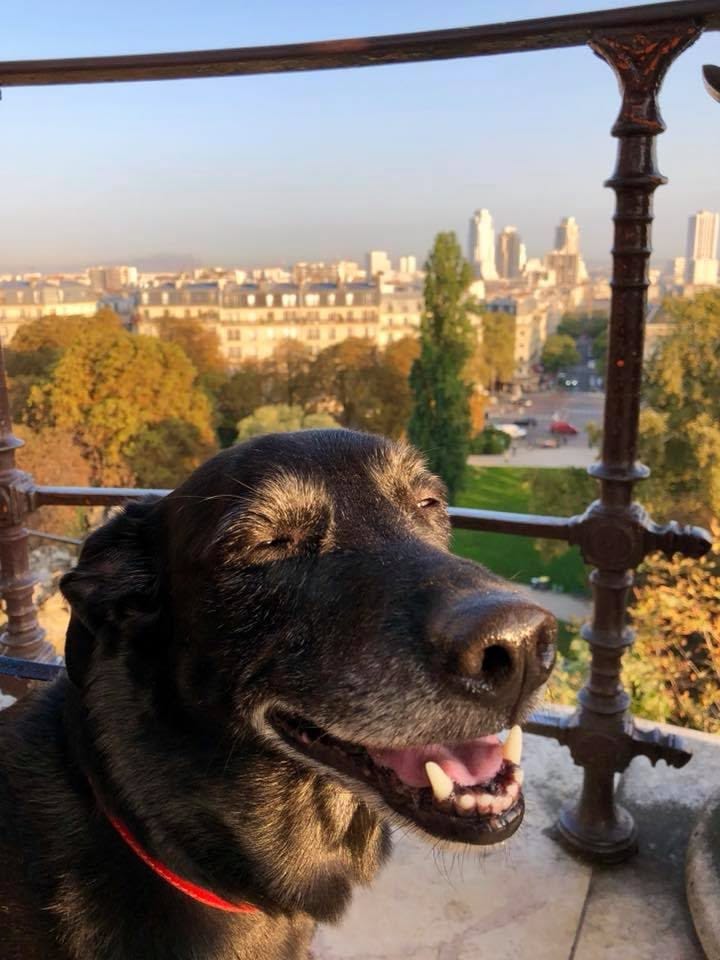
And the dog carries a burden the others do not: no one is allowed to speak for him. When people are dying in the same heat, who dares stand up for a dog? Say out loud that your animal suffocated on the sixth floor and the answer lands before you finish, people are dying, have some perspective, so you go quiet, because grief for a dog in a summer of human funerals feels indecent, and the silence gets read as the absence of a problem. The one resident who cannot say a word in his own defence is also the one his humans feel they have no standing to defend.
But this week the silence cracked a little. The associations filed their plea for the parks to open. A Paris councillor put a motion to the chamber asking the city to drop the dog ban in the heat. The ecologists tabled a plan for dog spaces within reach of every home. Voices are rising, and the question the heat keeps asking is whether anyone with the power to build will listen before the next dome of heat forms, which the forecasters are already watching take shape.
So the demand is not seasonal, and it is not sentimental. It is structural. Build the permanent thing, the shade, the water, the door that opens, for the city the next decade is already sending, not the one the postcard remembers. Stop measuring a heat policy by how loudly it is announced and start measuring it by who it leaves outside, because the resident with no voice, no vote and nowhere to go is the truest test of whether a city has been made liveable or only made to look it. We will know we have finally understood the heat on the day a dog in this city has somewhere to go that is not the floor.
—Datcha
I love in Arizona. The power went out for five minutes the other day and I was teetering on a full-blown panic by minute two. Where would I take the dogs? We were lucky, it came back on, and so did the Ac. Horrifying prospect without it. Paris is heartbreaking. Your writing is eloquent, even about this.
I am heartbroken. I live in Sacramento, California in the U.S., and our region has been built to withstand our high summer heats (100 - 112 degrees F) because of A/C. Otherwise, we would be in the same boat. 😥❤️